
The paperwork is almost signed...and we are OFF and RUNNING!
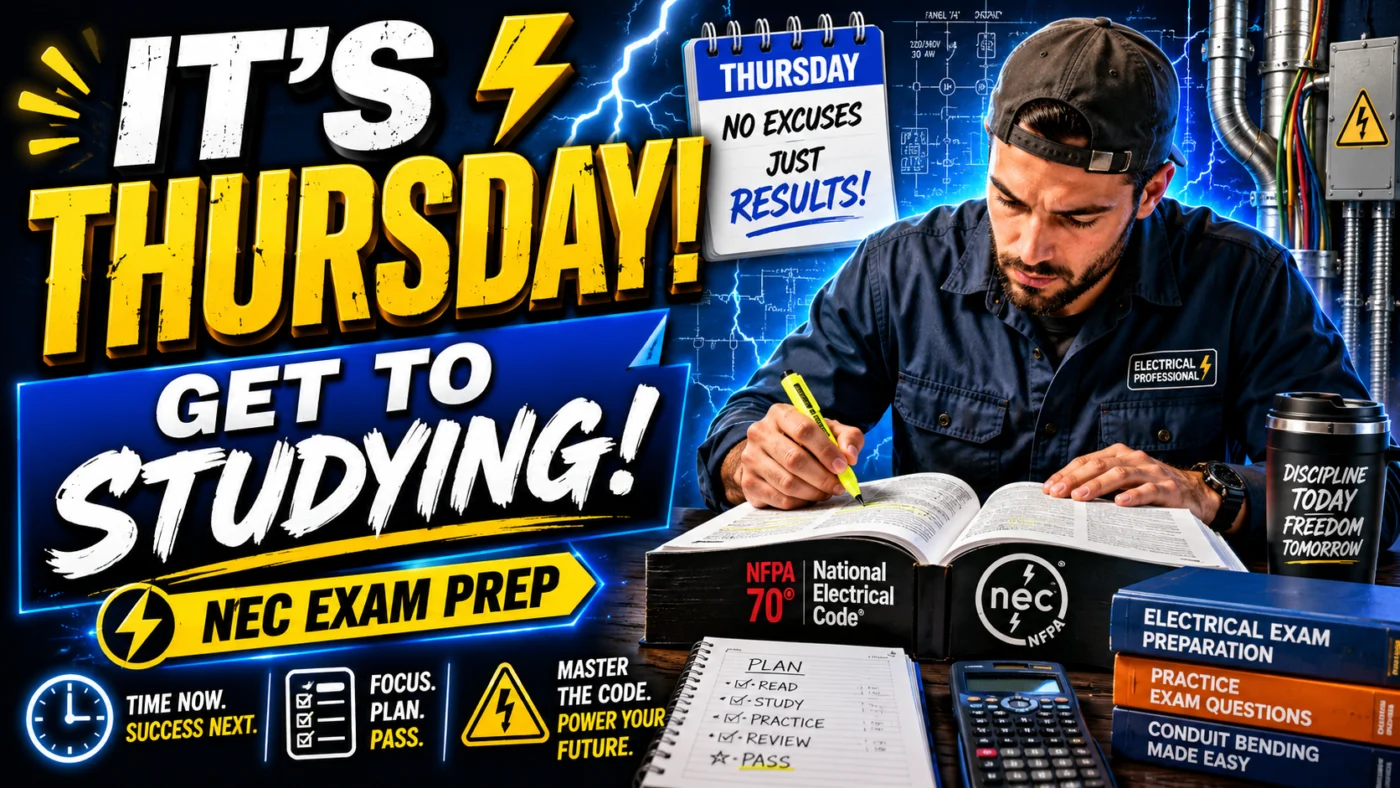
⚡ It’s Thursday — Get to Studying!
The week is not over yet.
If you are preparing for your electrical exam, Thursday is a great day to stop making excuses and get back into the material.
Not tomorrow.
Not this weekend.
Today.
🟨 You do not need a perfect study session.
You just need a productive one.
● Open the book.
● Start the lesson.
● Review the notes.
● Work the question.
● Look up the Code reference.
Do something that moves you forward.
---
🔵 Do Not Wait Until You “Feel Ready”
A lot of students lose time because they wait until they feel motivated.
Here is the truth:
⚡ Motivation usually shows up after you start, not before.
● You may not feel like studying.
● You may be tired.
● You may feel behind.
● You may have missed a few days.
● That does not mean you quit.
It means you restart.
---
🟩 Thursday Is a Good Reset Day
Use today to ask yourself:
🔎 What topic have I been avoiding?
📘 What Code article do I need to review?
🧠 What calculation keeps giving me trouble?
📝 What quiz did I miss that I need to understand?
🎯 What one thing can I improve before the weekend?
You do not have to fix everything today.
But you can fix something.
---
🟨 Study Like the Exam Is Coming
Because it is.
That exam does not care if you were busy.
It does not care if work was hard.
It does not care if you “meant to study.”
The exam only measures whether you can read the question, find the rule, apply the Code, and choose the correct answer.
So today, train for that.
📍 Read carefully.
🔑 Watch the control words.
📏 Pay attention to minimums and maximums.
🚫 Do not miss “not,” “except,” or “unless.”
✅ Prove your answer with the Code.
---
🟥 Stop Just Clicking Through Lessons
If you are taking an online course, do not confuse progress with understanding.
Finishing a lesson is not the same as learning the lesson.
After each section, ask yourself:
🧠 Can I explain what I just learned?
📘 Do I know where this is found in the Code?
⚡ Can I apply it to a question?
If not, slow down.
● Rewatch.
● Reread.
● Redo the question.
That is not failure. That is training.
---
🟦 Your Thursday Study Plan
Keep it simple:
⏱️ Study for 30 minutes.
📘 Review one Code topic.
📝 Work 10 questions.
🔎 Look up every missed answer.
🧠 Write down one thing you learned.
That is enough to build momentum.
And momentum matters.
---
⚡ Final Thought
You do not become a better Code student by wishing you understood the NEC.
You become better by opening it, reading it, working with it, and refusing to let confusion win.
So yes, it is Thursday.
The weekend is close.
But you still have today.
🟨 Get to studying.
🟩 Get one topic stronger.
🟥 Stop waiting for perfect.
⚡ The Code will not learn itself.
⚡ Struggling to Read the NEC? You’re Not Alone — But You Do Need a Better System
One of the biggest challenges I see with students studying the National Electrical Code is not always electrical knowledge.
Sometimes it is reading comprehension.
And before anyone takes that the wrong way, let me be clear:
🟨 Struggling to understand technical language does not mean someone is lazy, careless, or incapable.
The NEC is not written like a story. It is not casual reading. It is a technical, rule-based document filled with conditions, limitations, permissions, prohibitions, exceptions, and very specific words that control the meaning.
That means students cannot always read the NEC the same way they would read a normal book.
They need a method.
---
🔵 Start Small: Do Not Try to Swallow the Whole Rule at Once
When a student reads a Code rule and says, “I read it, but I don’t understand what it means,” the answer is usually not to say, “Just read it again.”
The better answer is to teach them how to break the rule down.
Read one small section at a time.
● One paragraph.
● One rule.
● Sometimes even one sentence.
Then stop and ask:
🧠 What is this actually talking about?
That one question can slow the brain down enough to start making sense of the words.
---
🟩 Use the Three-Question Check
After reading a rule, students should ask themselves three simple questions:
🔎 What is this rule talking about?
📍 When does this rule apply?
✅ What does it require, allow, or prohibit?
That is a powerful way to study the NEC because so many Code rules are condition-based.
In many cases, the rule is really saying:
⚡ When this condition exists, this requirement applies.
---
🟨 Watch the Control Words
Students also need to learn to watch for the small words that carry a lot of weight.
These are the words that control the meaning.
Words like:
⚠️ shall
🚫 shall not
✅ required
🟢 permitted
📍 where
🔁 if
🧩 unless
🚧 except
🎯 only
➕ and
🔀 or
📏 not less than
📐 not more than
Those words are not filler.
They are often the key to the answer.
For example:
🟦 “Shall” is not a suggestion.
🟥 “Shall not” is not optional.
🟨 “Where” usually introduces a condition.
🟧 “Unless” or “except” may change the application of the main rule.
🟩 “And” may mean multiple conditions must be satisfied.
🟪 “Or” may mean one condition or another is acceptable.
Many wrong answers on exams happen because the student missed one small word.
---
🟦 Rewrite the Rule in Plain Language
Another technique that works well is to have the student rewrite the rule in their own words.
Not in fancy language.
Not in instructor language.
Just plain language.
A student can simply write:
✍️ “This means…”
That little phrase forces the brain to process the meaning instead of simply looking at the words.
---
🟧 Turn Long Code Rules Into If / Then Statements
Another excellent strategy is to turn long NEC rules into this format:
🔹 IF this condition exists,
🔸 THEN this requirement applies.
That format helps separate the condition from the actual rule.
It also helps students avoid mixing together the location, the equipment, the permission, the limitation, and the exception.
This is especially important in an online course because the instructor is not sitting beside the student while they study.
The student has to learn how to self-check.
---
🎥 Use Pause and Replay in Online Lessons
For video lessons, the pause button is one of the best learning tools available.
Students should not let a video keep playing if the concept is not making sense.
⏸️ Pause the lesson.
🧠 Ask what was just explained.
↩️ Rewind 30 to 60 seconds if needed.
▶️ Watch it again.
There is no shame in replaying a technical explanation.
That is part of learning.
---
📝 Take Notes as Questions
Students can also benefit from taking notes as questions instead of only writing statements.
For example:
❓ When does this rule apply?
❓ What is the exception?
❓ What word makes this mandatory?
❓ Is this asking for the minimum or the maximum?
❓ Is this rule permitting something or prohibiting something?
When students ask questions while studying, they move from passive reading to active learning.
---
🟥 Slow Down on Online Quizzes
Online quizzes require the same discipline.
Before choosing an answer, students should slow down and identify what the question is actually asking.
Is it asking for:
📏 the minimum size?
📐 the maximum length?
✅ what is required?
🟢 what is permitted?
🚫 what is not allowed?
🧩 what exception applies?
A lot of exam mistakes happen because the student knows the concept but does not carefully read the question.
---
🔊 Use Read-Aloud Tools
Read-aloud tools can also help.
Some students comprehend better when they hear the words while reading them.
Browser read-aloud features, phone accessibility tools, tablet text-to-speech, and screen reader functions can be useful study aids.
🟨 That is not a shortcut. It is simply using the tools available to improve comprehension.
---
🚦 Use the Stoplight Method
Another helpful method is what I call the stoplight method.
After each lesson section, the student should rate their understanding:
🟢 Green: I understand this.
🟡 Yellow: I kind of understand it, but I need to review.
🔴 Red: I do not understand this yet.
The key is not to keep stacking new material on top of red areas.
That is how students get overwhelmed.
Go back.
Rewatch.
Reread.
Rebuild the foundation before moving forward.
---
⏱️ Use Shorter Study Sessions
Students with reading comprehension challenges often do better with shorter study sessions.
A good pattern is:
⏱️ 20 to 30 minutes of focused study
☕ Short break
🔁 Quick review
▶️ Then continue
That can be far more effective than forcing a long study session where the brain starts checking out.
---
📌 Do Not Confuse Finishing With Learning
In an online course, it is easy to click through lessons just to complete them.
But completing a lesson does not mean the material was understood.
A better goal is this:
🧠 Can I explain the basic idea to myself without looking at the page?
If the answer is yes, learning is taking place.
If the answer is no, that does not mean failure.
It simply means the student needs to slow down, break the material into smaller pieces, and work through it again.
---
⚡ Final Thought
The National Electrical Code rewards careful reading.
It is not about racing through the words.
It is about identifying the condition, understanding the requirement, recognizing the exceptions, and applying the rule correctly.
So if you are a student struggling to read the NEC, remember this:
🟦 Slow down.
🟨 Break it down.
🟩 Look for the control words.
🟧 Turn the rule into plain language.
🟥 Use pause and replay.
🟪 Check your understanding before moving forward.
The goal is not to finish quickly.
⚡ The goal is to understand accurately.


Well, it looks like I am going to be writing (6) articles for EC & M Magazine for a new Inspectors Intel Series. I will be writing articles on Inspectors and Electricians and answering code questions. The series will be every other month.
I will also be doing a video series like "Ask Paul" but for EC & M Magazine, and it will be 12 videos in the overall series.
Lastly, I will also be one of their NEC Consultants answering submitted questions in podcasts and videos.
Just wanted to share with you all first. This should all start, if all agreements are signed, by July 1.
Make it a MEMORABLE Day.

So, with all the false information online, such as folks posting on Crap Tok complaining about the NEC and making statements that its all about the "Manufacturers" and all that jazz. So, it begs me to ask the question.
Do YOU really know how the NEC is written and who writes it and what is NFPA's role in the process every 3 years.
Let's hear your thoughts.