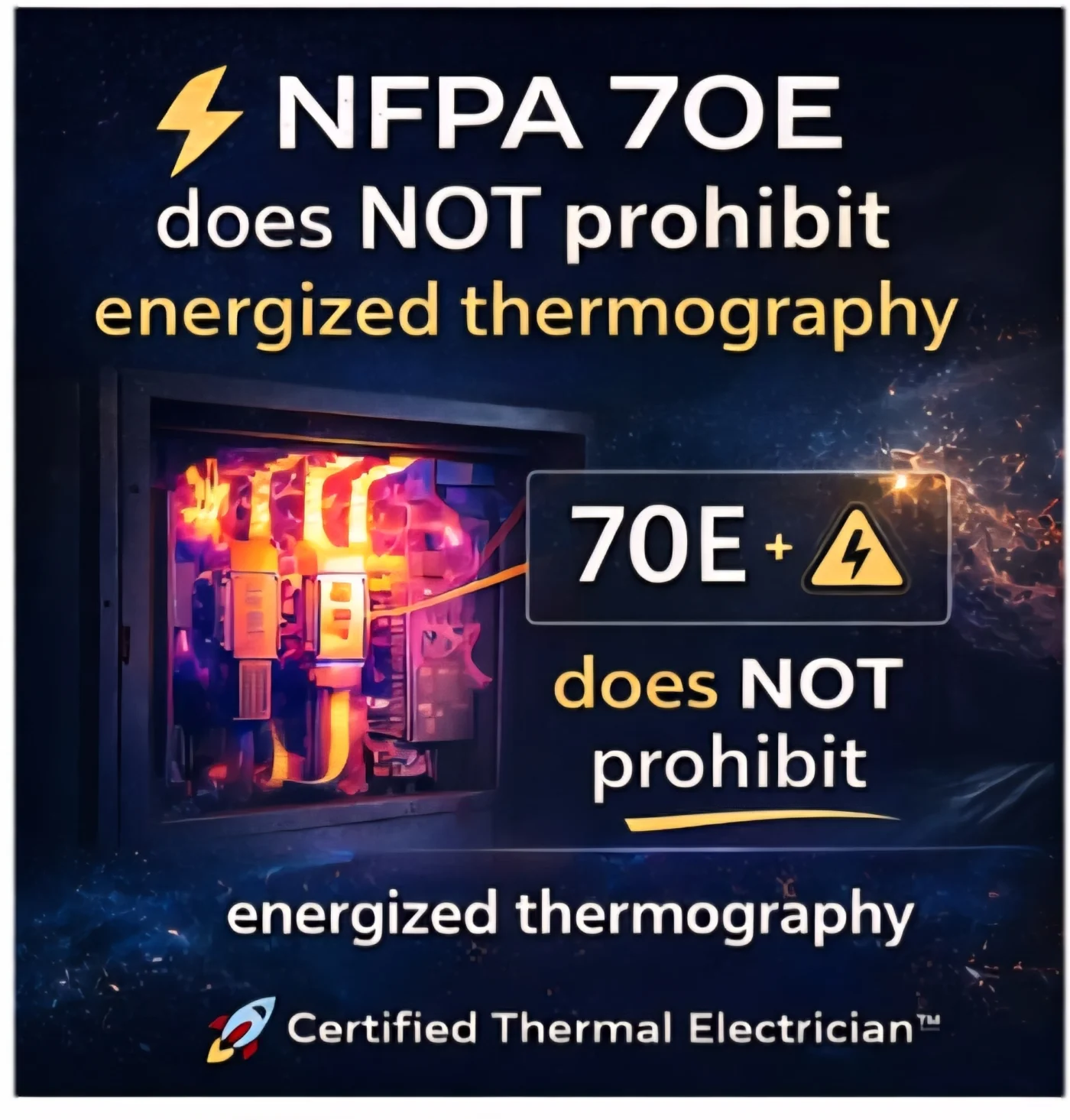


⚡ Why NFPA 70E Does NOT Prohibit Thermography on Energized Equipment — And Why NFPA 70B Now Makes It Essential
For years, many technicians have misunderstood NFPA 70E’s approach boundaries and assumed the standard is telling them they cannot open energized electrical equipment — especially 480-volt and even simple 120/240-volt panels — to perform inspections, diagnostics, or thermography.
That belief is not only incorrect — it is dangerous.
NFPA 70E is not a prohibition standard.
It is a risk-control framework.
It exists to ensure that when energized work is necessary, it is performed in a disciplined, engineered, and defensible manner.
⚡ The Biggest Misconception: “All Electrical Work Must Be De-Energized”
One of the most widespread misunderstandings in the electrical industry is the belief that electricians are required to de-energize all electrical equipment before performing any work — including simple 240-volt panels.
That is not what NFPA 70E says.
NFPA 70E requires that equipment be placed in an electrically safe work condition whenever feasible.
But the standard also clearly recognizes that many diagnostic, testing, troubleshooting, and commissioning tasks cannot be performed de-energized without invalidating the work.
Examples include verifying load conditions, identifying high-resistance terminations, evaluating thermal performance, confirming phase balance, and troubleshooting intermittent faults. These tasks are not unsafe — they are justified energized work when performed by qualified persons using proper controls.
Even on common 120/240-volt panels, NFPA 70E does not say “never open energized equipment.”
It says: Plan the task. Control the hazard. Protect the worker.
🎯 What NFPA 70E Actually Allows
Diagnostic testing — including infrared thermography — is widely recognized as justified energized work because de-energizing can be infeasible and would invalidate the inspection. The requirement is not “don’t do it.”
The requirement is “do it under controlled risk conditions.”
Thermography reveals failure modes that only exist under load: high-resistance connections, overloads, phase imbalance, harmonic heating, contact degradation, contamination, corrosion, vibration damage, and improper torque conditions. None of these can be properly evaluated with the equipment shut down.
🚧 Understanding the Boundaries Without the Confusion
NFPA 70E establishes invisible safety zones around exposed energized conductors. These boundaries do not prohibit work — they dictate the qualifications, procedures, and protective controls required as a worker moves closer to energized parts.
On typical 480-volt systems, the Limited Approach Boundary begins at approximately 3 ft 6 in. The Restricted Approach Boundary is roughly 12 in. The Arc Flash Boundary is determined by incident-energy analysis or arc-flash labeling.
These are not “no-go” zones — they are control zones.
🧠 How Certified Thermal Electricians™ Actually Work in the Field
Before any energized thermographic inspection begins, a Certified Thermal Electrician™ performs disciplined pre-task planning. This includes confirming inspection scope, verifying arc-flash labeling and incident energy, performing a documented shock and arc-flash risk assessment, establishing boundaries and barricades, selecting proper PPE, verifying tools, and confirming meaningful load conditions.
During the inspection, positioning, door control, stable stance, body placement outside the Restricted Approach Boundary whenever possible, and strict “inspection-only” scope discipline are enforced. Every image is documented with load, distance, emissivity method, ambient conditions, and viewing angle.
🏭 Real-World Example: Motor Control Centers
In a 480/277-volt MCC operating at 55–80% load, thermography routinely identifies bus joint heating from loose hardware and oxidation, stab connection heating from wear and contamination, starter termination heating from improper torque and strand damage, contact degradation inside contactors, and harmonic-related heating in VFD sections. These failure modes are invisible without energized inspection.
🧯 Real-World Example: Switchgear and Medium Voltage Equipment
On 480-volt switchgear, critical inspection targets include main and feeder breaker terminations, bus joints and transitions, disconnect fingers, neutral and ground terminations, and cable stress points.
In medium-voltage metal-clad gear, inspections focus on primary disconnect stabs, cable stress cones, PT/CT compartments, breaker interfaces, and abnormal heating that signals contamination, tracking, or insulation deterioration.
🪟 The Game-Changer: IR Inspection Windows
IR inspection windows allow thermal inspections with enclosure doors closed, dramatically reducing shock exposure, arc-flash risk, and PPE burden while improving compliance with NFPA 70E’s hierarchy of risk control and strengthening NFPA 70B maintenance programs.
📈 Why NFPA 70B Makes Thermography Essential
NFPA 70B now establishes thermography as a required part of an organized electrical maintenance program — including baseline scans, periodic re-inspections, trending analysis, corrective action documentation, and verification scans after repairs.
Thermography is no longer a “nice-to-have.”
It is a core reliability and safety function.
🏅 Why Certified Thermal Electricians™ Stand Apart
Certified Thermal Electricians™ are not camera operators.
They are safety professionals, diagnostics specialists, and reliability partners who understand both the electrical code and the physics of failure.
🚀 Want to Master This Skillset?
Become a Certified Thermal Electrician™
https://thermalelectrician.com
Professional training. Field-ready systems. Code-aligned documentation.