
Stop Chasing Ghost Voltage: Identifying Hi-Z vs Lo-Z on Your Digital Multimeter
- Posted by Paul Abernathy
- Date December 30, 2025
- Categories Blog
- Comments 0 comment
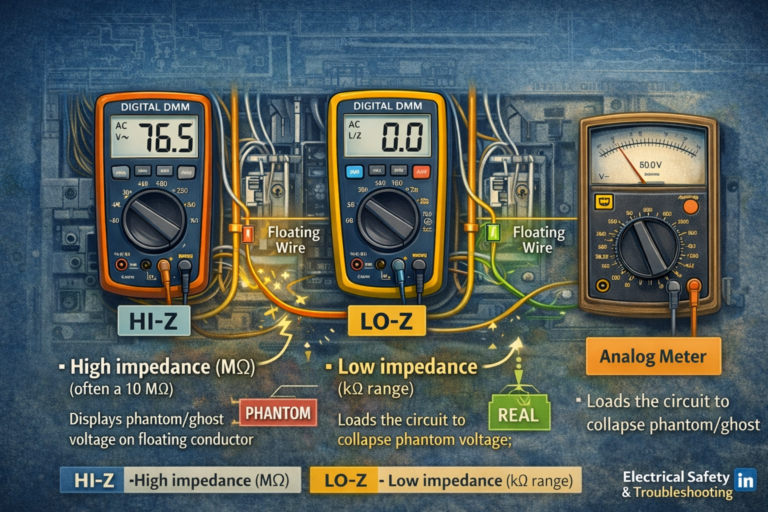
How to Tell if Your DMM is Hi-Z or Lo-Z (and Why It Matters in the Field)
Most digital multimeters used by electricians are high impedance (Hi-Z). That’s great for accuracy, but it can display phantom/induced voltage on floating conductors during absence-of-voltage verification. A meter with a true low impedance (Lo-Z) voltage function intentionally loads the circuit so weak coupled voltage collapses—helping you separate “meter readings” from a circuit that can deliver hazardous energy.
🧠1) What “Hi-Z” and “Lo-Z” Actually Mean
Input impedance is the resistance your meter presents to the circuit when measuring voltage. The higher the impedance, the less current the meter draws from the circuit.
| Term | Typical input impedance | What it does in the real world |
|---|---|---|
| Hi-Z DMM (most meters) | Often ~10 MΩ (may vary by range/mode) | Minimal loading; can display coupled/phantom/induced voltages on floating conductors |
| Lo-Z voltage mode (some meters) | Much lower than Hi-Z (varies by design; commonly in kΩ range) | Loads the circuit; weak induced/phantom voltage collapses; persistent voltage suggests real source/backfeed |
📄2) Fastest Way: Check the Meter’s Specs (The Right Line to Look For)
The most reliable answer is in the manufacturer documentation. You’re looking for either:
- “Input impedance” for voltage ranges (V AC / V DC)
- A dedicated function labeled “LoZ”, “Low Impedance”, “Low Z”, or similar
| What you see in the manual/specs | What it indicates | What to do next |
|---|---|---|
| “Input impedance: 10 MΩ” (for V ranges) | This is a standard Hi-Z DMM (normal behavior) | Use a Lo-Z method (if available) to check for phantom/induced voltage during troubleshooting |
| A separate dial position/button labeled “LoZ” | Meter has an intentional low impedance voltage function | Learn how to enable it and when to use it; it is not always default |
| “Input impedance varies with range” or “>10 MΩ” | Still Hi-Z for normal voltage; may change by mode (e.g., VFD/LPF) | Confirm behavior in the field using the controlled tests below |
🎛️3) Dial & Button Clues: What to Look For on the Meter Itself
Many electricians never notice Lo-Z because it can be a secondary function. Use these clues:
| Marking / behavior | What it usually means | Field confirmation |
|---|---|---|
| Dial position says “LoZ” or “V~ LoZ” | Dedicated low-impedance voltage test mode | Compare same point in V mode vs LoZ mode; ghost voltage should collapse in LoZ |
| A soft-key toggles “LoZ” on the screen while in V mode | LoZ is a selectable sub-function | Ensure LoZ icon is actually active before trusting the result |
| No LoZ anywhere; only standard V ranges | Likely a standard Hi-Z DMM only | Use a two-pole tester/approved Lo-Z method for “ghost” elimination |
🧪4) Field Confirmation Tests (No “Guessing” Required)
The goal is to perform a controlled comparison between Hi-Z and Lo-Z behavior. You don’t need to know the exact impedance number to confirm whether the meter is acting as Hi-Z only or has a Lo-Z mode.
Test A — “Floating conductor” comparison (common in buildings)
- Identify a known floating conductor (example: an open switch leg/traveler in a box, with an adjacent energized conductor present).
- Measure to equipment ground using your standard V mode (likely Hi-Z). Note the reading (often 20–90V in real scenarios).
- Now measure the same exact points using Lo-Z (if your meter has it) or using an approved low-impedance tester.
-
Interpret results:Reading collapses substantially in Lo-Z → confirms the voltage was largely coupled (phantom/induced).
Reading remains stable → treat as real source/backfeed until isolated and proven otherwise.
Test B — Load/bleed check (diagnostic concept)
Lo-Z functions act like a built-in “bleeder/load.” If your meter is Hi-Z only, the reading may remain because the meter itself is not discharging the coupled energy. In Lo-Z mode, the meter provides that discharge path and the voltage tends to collapse quickly.
🧭5) Testing Ghost/Phantom Voltage with an Analog Meter (When You Don’t Have Lo-Z)
A traditional analog (needle) voltmeter can be a powerful tool for distinguishing phantom/induced voltage from a real energized/backfed source. The reason is simple: many analog meters present a lower input impedance than a modern digital meter in standard V mode, so the meter itself provides circuit loading that collapses weak coupled energy.
Why an analog meter “works” for this test
Phantom voltage is often produced by capacitive coupling to a floating conductor. A Hi-Z digital meter draws so little current that the coupled charge can create a measurable voltage at the meter input. An analog meter draws more current, effectively acting like a built-in “bleed” path. If the voltage source cannot supply meaningful current (phantom/induced), the indication falls toward zero.
| Instrument / Mode | Typical impedance behavior | What you’ll see on ghost voltage |
|---|---|---|
| Hi-Z DMM (standard V) | Very high input impedance (often ~10 MΩ) | Displays ghost/phantom easily; readings may be “stable enough” to confuse troubleshooting |
| Analog meter (needle) | Lower impedance; depends on Ω/V rating & selected range | Needle barely deflects or decays back toward zero if the voltage is only coupled |
| Lo-Z function (digital LoZ) | Intentionally low impedance loading | Ghost collapses; persistent voltage suggests real source/backfeed |
Analog meter field procedure (practical and repeatable)
- Verify the meter on a known live source (or proving unit) before starting.
- Select the proper AC volts range (start high, then step down as needed) to avoid pegging the needle.
- Measure the suspect conductor to a known reference point (equipment grounding conductor or bonded enclosure).
-
Watch the needle:Phantom/induced: needle barely moves, is weak/unstable, or decays toward zero as the coupled charge bleeds off.
Real/backfed: needle produces a firm, repeatable deflection that does not collapse. - Re-verify the meter on the known live source (or proving unit) after testing.
⚡Why This Matters Under NFPA 70E (Practical Implications)
When you are verifying absence of voltage to establish an electrically safe work condition, a Hi-Z DMM can display a voltage on a conductor that is not capable of delivering meaningful current. That creates confusion and can lead to two dangerous behaviors:
- False alarm behavior: “It reads 60V so it must be live,” even when Lo-Z shows it collapses and the conductor is floating.
- False confidence behavior: “It must be ghost,” even when Lo-Z indicates voltage persists (suggesting backfeed).
🧾Quick Checklist: How to Identify Hi-Z vs Lo-Z in 60 Seconds
| Check | What you’re looking for | What it means |
|---|---|---|
| Manual/spec sheet | Input impedance listed for V ranges; any LoZ function mentioned | 10 MΩ indicates Hi-Z; LoZ indicates a selectable low-impedance mode exists |
| Dial markings | “LoZ” / “V~ LoZ” printed on dial or screen | You have a true Lo-Z function (when selected) |
| Display icon | LoZ indicator appears when engaged | Lo-Z is active; without the icon you may still be in Hi-Z mode |
| Field comparison | Same point reads high on V mode but collapses on LoZ | Confirms coupled/phantom voltage is being displayed in Hi-Z mode |
© Educational content. Always follow NFPA 70E, your company electrical safety program, and the instrument manufacturer’s instructions when verifying absence of voltage.

CEO and Founder of Electrical Code Academy, Inc. A Virginia Corporation located in Mineral, Virginia and Creator of the CMECP® Program.
You may also like
The 100 Megohm Myth: Why IR Testing Cannot Reliably Condemn Individual Insulated Conductors Without a Valid Conductive Return Path
⚡ Technical Analysis • Insulation Resistance Testing The 100 Megohm Myth: Why Megohmmeter Testing of Individual Insulated Conductors Can Be Misleading Without a Valid Return Path Insulation-resistance testing of individual insulated conductors is routinely misunderstood in the electrical industry. One …
Trulight™ switches to Tinned Copper
Why TruLight’s Move to Tinned Copper Is a Smart Engineering Decision By Paul Abernathy Director of Technical Services, Prysmian Electrical Code Academy, Inc. When we evaluate an electrical product, one of the most important questions we can ask is not …
Big News: Electrical Code Academy Teams Up with EC&M Magazine to Bring NEC Insight to the Industry
⚡ Major Industry Announcement Big News: Electrical Code Academy Teams Up with EC&M Magazine to Bring NEC Insight to the Industry A powerful new collaboration is coming to the electrical industry, bringing practical NEC education, inspection insight, electrician-focused discussion, and …