
Effective Value or Root Means Square Explained
- Posted by Paul Abernathy
- Categories Blog
- Date April 12, 2023
- Comments 0 comment
Effective Value / Root Means Square (RMS)
Effective Values
The effective value of an AC is that value that will produce the same heating effect as a specific value of a steady DC. In other words, an AC has an effective value of 1 ampere if it produces heat at the same rate as the heat produced by 1 ampere of DC, both flowing in the same value of resistance.
Another name for the effective value of an AC or voltage is the root-mean-square (rms) value. This term was derived from one method used to compute the value. The rms is calculated as follows: The instantaneous values for one cycle are selected for equal periods of time. Each value is squared, and the average of the squares is calculated. (Values are squared because the heating effect varies as the square of the current or voltage.) The square root of this answer is the rms value.
A more accurate method requires the use of calculus. Either method shows that the effective or rms value is 0.707 times the maximum or peak (p) value. A simple equation for calculating the effective value is shown as follows:
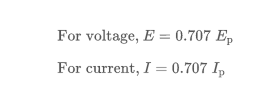
where subscript “p” refers to the peak value
When an AC or voltage is specified, it is always the effective value that is meant, unless otherwise stated. Standard AC meters indicate effective or rms values.

How to Pass the Electrician Exam on Your First Try
Standardizing Electrical Thermal Inspections: Why Certified Thermal Electricians Rely on the Mileseey TR20 Pro for Accurate, Repeatable Thermography
Stop Chasing Ghost Voltage: Identifying Hi-Z vs Lo-Z on Your Digital Multimeter
Virginia Journeyman and Master Electrical Exam Prep
Selective Coordination in Article 700: Stop Forcing a 0.1-Second Rule That Doesn’t Exist
NECA Question of the Day | Voltage Drop
CEO and Founder of Electrical Code Academy, Inc. A Virginia Corporation located in Mineral, Virginia
You may also like
Grounding vs Bonding in the 2026 NEC: Equipment Grounding Conductors, Bonding Jumpers, and Article 250 Explained
⚡ 2026 NEC • Article 250 Technical Review Grounding Conductors vs. Bonding Conductors in the 2026 NEC:Stop Calling Everything a “Ground” One of the biggest reasons Article 250 still creates confusion in the field is because people use the word …
2026 NEC • Article 392 • Student Lesson Can Single Insulated Conductors Like THHN Be Installed in Cable Trays? Article 392.10 is one of those NEC sections that sounds simple until you slow down and separate two very different questions: …
Selective Coordination in Article 700: Stop Forcing a 0.1-Second Rule That Doesn’t Exist
⚡ Selective Coordination in NEC 700: The 0.1-Second Myth Needs to Go Selective coordination is one of those topics that sounds simple until people start blending rules from different occupancies and different Code sections. That is where the confusion starts. …