
Phantom, Backfed & Induced Voltage — Field Testing for NFPA 70E Compliance
- Posted by Paul Abernathy
- Categories Blog
- Date December 30, 2025
- Comments 0 comment
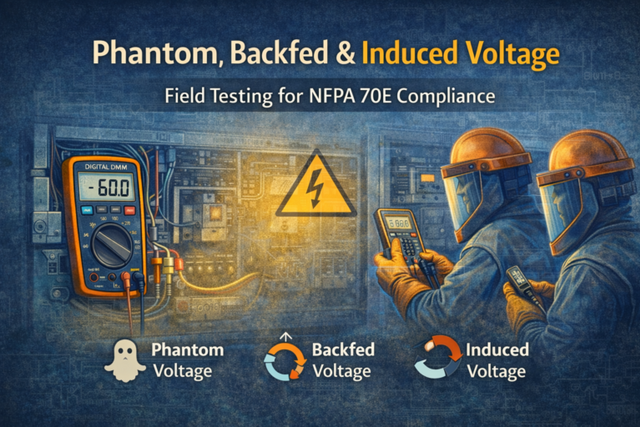
Phantom, Backfed & Induced Voltage — Field Testing for NFPA 70E Compliance
When verifying absence of voltage to establish an electrically safe work condition, electricians often encounter unexpected voltage readings on conductors believed to be deenergized. This guide explains phantom (ghost) voltage, induced voltage, and backfed voltage—and provides field-ready steps to determine whether a reading is merely a coupled artifact or a circuit capable of delivering hazardous energy.
👻1) Phantom (Ghost) Voltage — What It Is
Phantom voltage is a measurable voltage present on a conductor that is not intentionally energized. In typical building wiring, the primary mechanism is capacitive coupling: a deenergized conductor running parallel to an energized conductor forms a distributed capacitance. A high-impedance digital multimeter (Hi-Z DMM) draws extremely little current (commonly ~10 MΩ input impedance), allowing a small displacement current to develop a measurable voltage at the meter—even though available current may be negligible.
Where phantom voltage commonly shows up
| Scenario | What you see | What’s actually happening |
|---|---|---|
| Open switch leg / traveler | 40–90V to ground on Hi-Z; may drift | Distributed capacitive coupling from adjacent energized conductor(s) |
| Spare/floating conductor in raceway with energized feeders | Voltage varies by location along run | Cc increases with length; floating conductor “charges” relative to ground |
| Control conductors bundled with power | Unexpected voltage with no load | Coupling into high impedance circuits and meter inputs |
🔁2) Backfed Voltage — What It Is (and Why It’s Dangerous)
Backfed voltage is voltage being supplied into a circuit from an unintended source or path. Unlike phantom/induced voltage, backfeed can have real available current—enough to shock, arc, energize equipment, or defeat your lockout assumptions. Backfeed is a source/path problem, not a “meter problem.”
Common backfeed sources (real-world)
| Source type | How it backfeeds | Field clue |
|---|---|---|
| UPS / inverter / generator | Output energizes downstream conductors even with utility source opened | Voltage remains stable under Lo-Z; may power loads |
| PV system / ESS (storage) | Multiple disconnect points; interconnections energize sections unexpectedly | “Dead” conductors remain energized after opening one disconnect |
| Control power transformer | Secondary feeds controls; miswiring/return paths energize conductors | 120V persists in control cabinet with main open |
| Emergency/ATS systems | Emergency source present while normal source is opened | Two-source labeling; separate feeders; voltage stable |
| MWBC/shared neutral issues | Improper disconnecting means or shared return path creates unexpected energization | Odd readings to neutral/ground; circuit behavior abnormal |
🧲3) Induced Voltage — What It Is
Induced voltage is commonly used in the field to describe voltages appearing on a conductor due to nearby energized conductors/equipment. Two mechanisms are involved:
- Capacitive (electric field) coupling: dominant in many building wiring scenarios (also the primary driver behind many “phantom” readings).
- Inductive (magnetic field) coupling: increases where adjacent conductors carry higher current and have long parallel exposure.
Why induced readings matter for NFPA 70E verification
The field objective is determining whether the circuit is capable of delivering hazardous energy, not merely whether a Hi-Z meter displays a number. Induced/phantom voltage is a common reason electricians get conflicting “dead vs not dead” readings during absence-of-voltage verification.
🧰4) Hi-Z vs Lo-Z — How to Tell What Your Meter Is Doing
Most standard digital multimeters are high impedance (Hi-Z). That’s great for precision, but it can reveal phantom/induced voltages. A Lo-Z method intentionally applies a lower impedance load, collapsing weak coupled voltage and helping differentiate “measured voltage” from “available energy.”
Practical behavior comparison
| Tester / Mode | What it does electrically | What you learn in the field |
|---|---|---|
| Hi-Z DMM (typical) | Minimal loading (often ~10 MΩ input) | Can display ghost/induced on floating conductors |
| Lo-Z mode (if equipped) | Applies lower impedance load to the circuit | Ghost often collapses; persistent voltage suggests real source |
| Two-pole tester (policy-approved) | Typically lower impedance than a DMM | More resistant to ghost readings; fast “is it real?” check |
| Solenoid tester (policy-approved) | Strong loading; responds to available current | Very effective at eliminating ghost—when permitted |
🧭Field Workflow: Steps to Narrow Down What You’re Seeing
This workflow is designed for real field conditions. It helps you separate a “meter reading” from a circuit capable of delivering energy. The goal is repeatable, defensible absence-of-voltage verification supporting NFPA 70E compliance.
Step 1 — Establish correct test posture
- Open and secure the correct disconnecting means (not just a local control switch).
- Verify the tester on a known live source (or proving unit).
- Test all relevant combinations: phase-to-phase, phase-to-neutral, phase-to-ground (as applicable).
- Re-verify the tester on the known source after testing.
Step 2 — If voltage appears on a “deenergized” conductor
- Immediately repeat with a Lo-Z method (Lo-Z mode, two-pole tester, or other approved low-impedance test).
- Interpret behavior:Collapses quickly under Lo-Z → strongly suggests phantom/induced (low available current).
Remains stable under Lo-Z → treat as backfed/energized until the source/path is identified and opened. - Change reference points (equipment ground vs grounded conductor vs known bonded point) and confirm consistency.
- Test at multiple locations (panel end vs field end). Coupled voltages often vary with length/location.
Step 3 — Validate by isolation (segment testing)
- Identify adjacent energized sources (parallel raceways, shared trays, nearby feeders, motor circuits).
- Open the conductor at a known point (terminal block/splice/disconnect) so each segment can be tested independently.
- Re-test each segment using Hi-Z and Lo-Z. A backfeed may remain on one side while the other collapses.
- Confirm multi-source systems: normal + emergency, generator + utility, UPS, PV/ESS, and control power sources.
Step 4 — If Lo-Z still shows voltage, locate the backfeed source/path
- Stop and treat as energized. Do not proceed assuming it is “ghost.”
- Verify all sources are opened: normal, emergency, UPS/inverter, PV/ESS, generator, control power transformers.
- Open downstream equipment points as needed per procedure to remove the backfeed path and re-test after each step.
- Investigate neutral/ground anomalies: shared neutrals, MWBC errors, loose neutrals, mislanded conductors can create confusing readings.
🧪Field Examples: What Electricians Commonly See
Example 1 — Switch leg shows ~60V with breaker OFF (lighting circuit)
Symptoms: A switched conductor reads ~40–80V to ground with a Hi-Z DMM when the breaker is off and the switch is open. The reading may drift or change when leads are moved.
Likely cause: Phantom voltage due to capacitive coupling from adjacent energized conductors in the same cable/raceway.
Example 2 — “Dead” conductor in a tray reads 30–90V (parallel to a loaded feeder)
Symptoms: A spare/disconnected conductor in a cable tray reads measurable voltage to ground; the reading changes by location along the tray.
Likely cause: Induced/coupled voltage from long parallel exposure to energized conductors carrying significant load current.
Example 3 — Circuit shows a steady 120V even after breaker is opened and locked out
Symptoms: Voltage remains stable and repeatable to neutral/ground under both Hi-Z and Lo-Z testing.
Likely cause: Backfed voltage from another source/path (UPS/inverter, PV/ESS, emergency feed, control transformer, MWBC/shared neutral errors).
Example 4 — Strange low voltage readings and equipment “acts alive” (loose/open neutral)
Symptoms: Confusing voltage readings; readings change dramatically depending on reference point; loads behave abnormally.
Likely cause: Floating conductor conditions due to loose/open neutral, MWBC issues, or poor bonding/reference integrity.
🧾Quick Decision Summary
| What you see | Most likely cause | Next best action |
|---|---|---|
| Voltage appears on Hi-Z; collapses on Lo-Z | Phantom/induced (low available current) | Validate by location/segment testing; document; complete verification per program |
| Voltage varies by location along run | Induced/coupled (distributed effect) | Compare Hi-Z vs Lo-Z; isolate ends/segments if needed |
| Voltage remains stable under Lo-Z | Backfed/real source | Treat as energized; identify/open all sources & paths; re-test after each isolation |
| Readings change with reference point | Floating neutral/incorrect reference | Test all combinations; verify grounded conductor and bonding reference |
© Educational content. Always follow NFPA 70E, your company electrical safety program, and test instrument instructions when verifying absence of voltage and establishing an electrically safe work condition.

CEO and Founder of Electrical Code Academy, Inc. A Virginia Corporation located in Mineral, Virginia
Step-by-Step: NFPA 70E + NFPA 70B Compliance for Electrical Thermography
You may also like
How to Tell if Your DMM is Hi-Z or Lo-Z (and Why It Matters in the Field) Most digital multimeters used by electricians are high impedance (Hi-Z). That’s great for accuracy, but it can display phantom/induced voltage on floating conductors …
Step-by-Step: NFPA 70E + NFPA 70B Compliance for Electrical Thermography
🚀 Become Certified Field Playbook Step-by-Step: NFPA 70E + NFPA 70B Compliance for Electrical Thermography A practical, repeatable workflow for the most common electrical thermography tasks—built around NFPA 70E risk control (shock + arc-flash exposure management) and NFPA 70B maintenance …
Thermography on Energized Electrical Equipment — Advanced NFPA 70E & NFPA 70B Compliance Guide for Certified Thermal Electricians™
Thermography on Energized Electrical Equipment — Advanced NFPA 70E & NFPA 70B Compliance Guide for Certified Thermal Electricians™ 🚀 Become Certified Thermography on Energized Electrical Equipment — Advanced NFPA 70E & NFPA 70B Compliance Guide for Certified Thermal Electricians™ A …